Gaming community ask, R U OK?
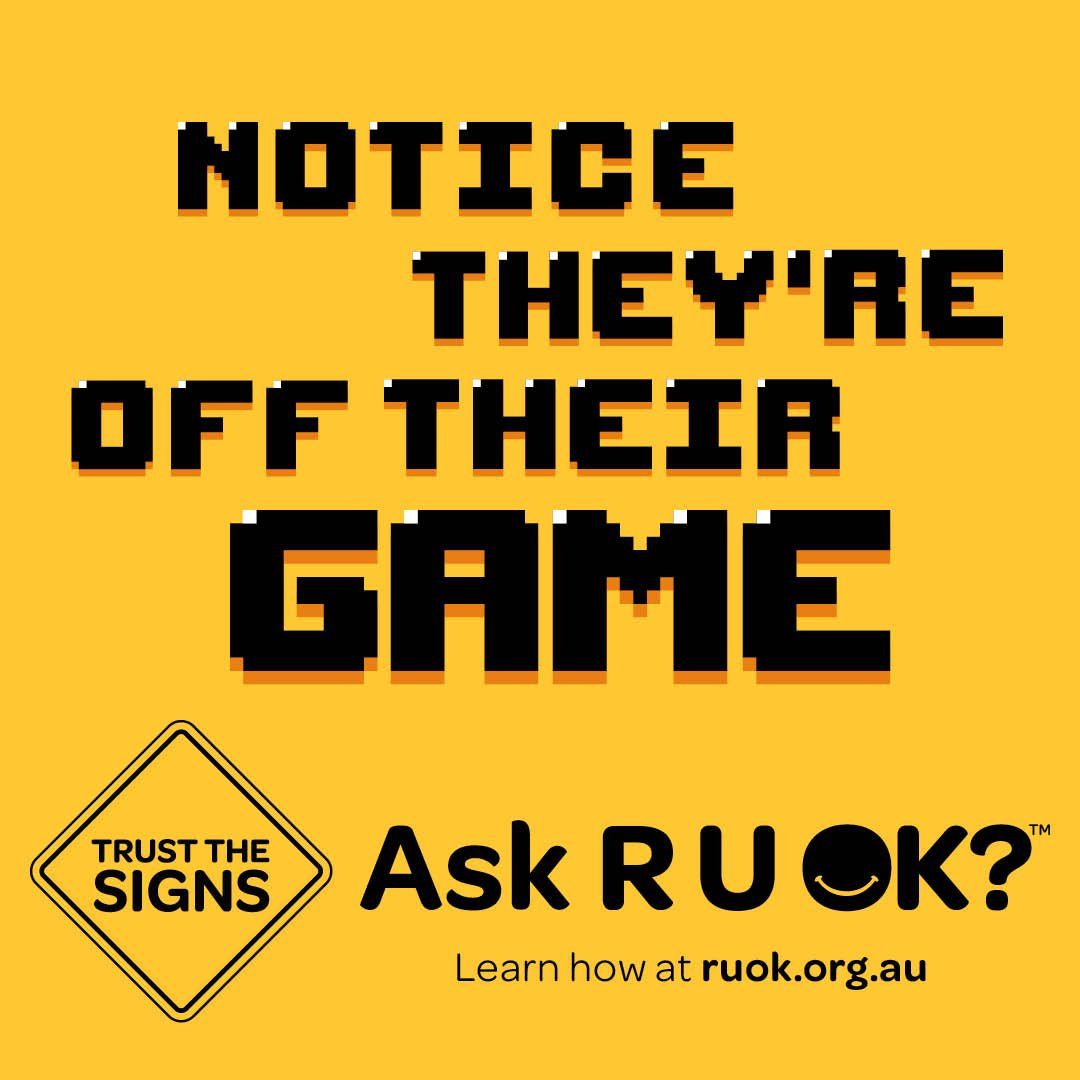
R U OK? and Goto.Game are working together to inspire and empower Australian gamers to connect with the people around them and check in on each other in the build-up to R U OK? Day, 12 September 2019.
This year’s R U OK?Day is about encouraging everyone to Trust the Signs, Trust their Gut and Ask R U OK?. Recent research from R U OK? has revealed that only 44% of 18-34 year old’s believe they are confident they knowing the signs to look for that could indicate someone’s struggling with life. According to market research company Newzoo, 12.4 million Australians play video games. As the average age of gamers is 34, and 78% of gamers are 18 or older: the gaming community represents an important audience for R U OK?.
The campaign will use creative with the tagline ‘Noticed they’re off their game? Trust the Signs and Ask R U OK?’ to inspire the gaming community to the learn when and how to ask R U OK? Goto.game influencers will educate their Twitch, Twitter, Instagram, Facebook and LinkedIn followers on what someone might be saying or doing and what might be going on in their life when they’re struggling while sharing personal stories of the times a conversation changed a life to encourage everyone to ask the question.
Influencers will be invited to connect to Goto.game’s parent company Digivizer ’s platform to allow real-time insights into all owned and earned media for this R U OK? campaign.
Phid McAwesome, Head of Goto.game, said: “In recent years we have lost some amazing people in the industry to suicide, and we want to be part of the solution. For us this is about helping prevent suicide and openly discussing life’s ups and downs. The gaming community is very social and connected. Our job is to help our community understand that you don't need to be an expert to reach out to someone you’re worried about - just be a good friend and a great listener.
“So it’s important that we deliver results for R U OK?, around awareness and engagement, educating the gaming community about the early signs that someone might need some extra support . Our connections with the gaming community and its influencers, working for companies such as Bethesda Softworks, Bluemouth, Lenovo, Intel and Alienware, and the Digivizer technology we use to measure in real-time the effectiveness of activation and digital programs, are a powerful combination for R U OK?.”
CEO of R U OK? Katherine Newton says raising awareness across the gaming community is an important part of this year’s R U OK?Day.
"We're pleased to have the opportunity to spread the R U OK? message to a
new audience through Goto.game’s community," Newton said
"We know that gaming can provide a sense of belonging and it is this
social connectedness that can help gamers look out for each other both online
and offline, and trust their gut-instinct when they notice signs that someone
might be struggling with life.
“Signs can be subtle changes in verbal or non-verbal behaviour. Someone might tell you they’re having difficulty switching off, or a mate might not be turning up to social events. We’re encouraging people to look out for those cues. We can also make a conscious effort when we know someone is going through a significant life change such as job loss, relationship breakdown, study pressure or perhaps becoming a parent.”
Gaming can be a powerful support mechanism for anyone struggling with concerns, worries or other stresses. According to the Digital Australia 2020 Report from Bond University and the Interactive Games & Entertainment Association (IGEA), 74% of video gamers believe gaming improves mental well-being, 70% say it reduces anxiety, and 66% say gaming improves social well-being.
The Bond University/IGEA research also cites gamers’ personal experiences: some gamers bond or meet for the first time while playing, others like it that the gaming community accepts that “weird and wonderful is OK”, gaming helps some connect with others when feeling lonely, and for some, playing games helps them find refuge from being bullied in the real world.
R U OK?Day is a national day of action, held on the second Thursday of September each year. But every day is a great day to start a conversation. Conversation tips and crisis support numbers can be found at ruok.org.au .
ENDS
For more information:
●Alan Smith, Head of Strategic Business Communications, Digivizer. Tel: +61 404 432 700. [email protected]. Twitter: @alansmithoz
●Annabel Bowman, PR & Media Manager R U OK? Tel: 0411 084 186. [email protected]
About Goto.game
Goto.game is at:
Twitter: https://twitter.com/gotogame
Facebook: https://www.facebook.com/GoToGamers/
Twitch: https://www.twitch.tv/gotogame
Instagram: https://www.instagram.com/goto.game/
Web: www.goto.game
About
R U OK?
R U OK? is a not-for-profit organisation that aims to inspire and empower everyone to meaningfully connect with people around them and support anyone struggling with life.
R U OK?Day is a national day of action, held on the second Thursday of September each year. But every day is the day to start a conversation.
Conversation tips and crisis numbers can be found at ruok.org.au .