| Rowena Saheb, Wellbeing Coordinator at Western Sydney University, has received the ‘Education’ Award at the inaugural Barbara Hocking Memorial Awards.
Held in Sydney by suicide prevention organisation R U OK?, the Awards recognise efforts to create a world where we are all connected and protected from suicide across five categories; Workplace, Education, Community, Conversation Champion and Young Conversation Champion.
The panel took the time to celebrate Rowena’s significant contribution to suicide prevention work which has opened up the conversation for many in the Western Sydney University community.
“We were truly inspired by the work of all the nominees for the inaugural Barbara Hocking Memorial Awards. The support of the community is invaluable in helping us to spread the R U OK? message and it’s important that we let them know how much we appreciate their contribution,”
said Katherine Newton, CEO R U OK?
“Rowena’s work spreading the R U OK? message within the Western Sydney University community has delivered real impact, encouraging others to have regular, meaningful conversations and invest more time in the people around them.”
Drawing on her own lived experience, the experiences of those around her, and a genuine passion for the wellbeing of young people, Rowena works tirelessly and effectively in building Western Sydney University’s capacity to empower staff and students to start meaningful conversations.
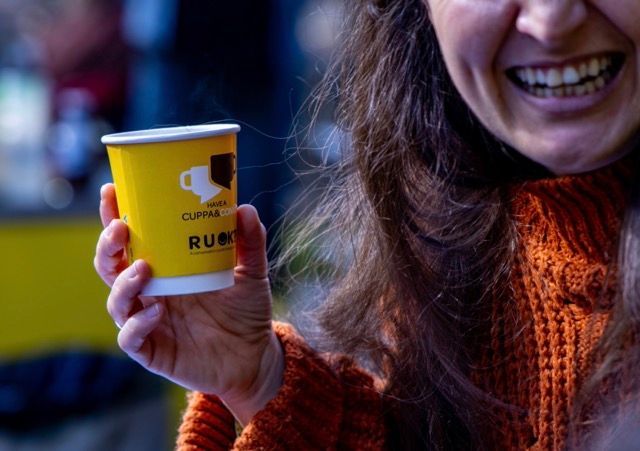
Rowena has coordinated an R U OK? ‘cuppa and a convo’ initiative to encourage staff and students to reach out to their peers and ask the question, R U OK? To support the facilitation of these conversations, Rowena has negotiated a 2 for 1 coffee promotion across Western Sydney University Campuses; specifically, any community member can take the time to check in with their peer or colleague, and the coffee for the peer or colleague is paid for by the university. Across all campuses, an average Thursday sees the distribution of approximately 1,000 cups of coffee.
Rowena also coordinated the simultaneous delivery of all Western Sydney University R U OK?Day 2018 events, including eight whole of campus R U OK?Day events and 10 remote campus activations. To increase her delivery capability, Rowena developed a volunteer recruitment strategy. This resulted in:
- Over 140 expressions of interest to volunteer
- Over 120 students and staff receiving RU OK?Day training
- 114 students volunteering four hours of the day to partner in the delivery of these events
Event evaluation showed over 1,200 R U OK? conversations took place across Western Sydney University as a result of the events, with many referrals being made to the university counselling service and external support services.
Rowena gratefully accepted the Award and spoke of her passion for the normalisation of meaningful conversations.
"It's truly overwhelming, but it's just the most amazing opportunity to give more of a voice to this initiative and to young people at the uni,"
said Saheb .
The Awards also celebrated the life of Barbara Hocking OAM (d. 2016), one of Australia's leading advocates for people affected by mental illness.
“ Barbara’s leadership and achievements positively changed how people living with mental illness and their families are treated and regarded,”
said R U OK? Chair Mike Connaghan of Ms Hocking’s legacy.
“These Awards honour Barbara’s lifelong commitment to peer-to-peer support, highlighting the opportunity we all have to start a meaningful conversation with someone we feel might be struggling with life. She was the first person from the mental health sector who believed in the merit the R U OK? mission to break down stigma and encourage more meaningful conversations.”
Details of all categories, finalists and winners for The Barbara Hocking Memorial Awards can be found on the R U OK? website at www.ruok.org.au/barbara-hocking-memorial-award
About the Barbara Hocking Memorial Awards:
The Barbara Hocking Memorial Awards are organised by suicide prevention organisation R U OK? and recognise those who help create a world where we are all connected and protected from suicide.
Barbara Hocking OAM (d. 2016) was one of Australia's leading advocates for people affected by mental illness. Her leadership and achievements positively changed how people living with mental illness and their families are treated and regarded. Barbara was the first full-time Executive-Director of SANE Australia - a national charity working for a better life for all people affected by mental illness through education and support, applied research and campaigning for improved services and attitudes. As well as being a Director of SANE Australia, she also served on the boards of Mental Health Australia and R U OK?
The Barbara Hocking Memorial Awards aim to:
- recognise and celebrate the people and organisations who have made an outstanding contribution to support R U OK? in their community
- inspire others to support R U OK?
- encourage others to have regular meaningful conversations and invest more time in the people around them.
|