A marathon effort: How preparation and support helped me run 50km
<!-- /* Font Definitions */ @font-face {font-family:"Cambria Math"; panose-1:2 4 5 3 5 4 6 3 2 4; mso-font-charset:0; mso-generic-font-family:roman; mso-font-pitch:variable; mso-font-signature:3 0 0 0 1 0;} @font-face {font-family:Calibri; panose-1:2 15 5 2 2 2 4 3 2 4; mso-font-charset:0; mso-generic-font-family:swiss; mso-font-pitch:variable; mso-font-signature:-536859905 -1073732485 9 0 511 0;} /* Style Definitions */ p.MsoNormal, li.MsoNormal, div.MsoNormal {mso-style-unhide:no; mso-style-qformat:yes; mso-style-parent:""; margin:0cm; margin-bottom:.0001pt; mso-pagination:widow-orphan; font-size:12.0pt; font-family:"Calibri",sans-serif; mso-ascii-font-family:Calibri; mso-ascii-theme-font:minor-latin; mso-fareast-font-family:Calibri; mso-fareast-theme-font:minor-latin; mso-hansi-font-family:Calibri; mso-hansi-theme-font:minor-latin; mso-bidi-font-family:"Times New Roman"; mso-bidi-theme-font:minor-bidi;} .MsoChpDefault {mso-style-type:export-only; mso-default-props:yes; font-family:"Calibri",sans-serif; mso-ascii-font-family:Calibri; mso-ascii-theme-font:minor-latin; mso-fareast-font-family:Calibri; mso-fareast-theme-font:minor-latin; mso-hansi-font-family:Calibri; mso-hansi-theme-font:minor-latin; mso-bidi-font-family:"Times New Roman"; mso-bidi-theme-font:minor-bidi;} @page WordSection1 {size:612.0pt 792.0pt; margin:72.0pt 72.0pt 72.0pt 72.0pt; mso-header-margin:36.0pt; mso-footer-margin:36.0pt; mso-paper-source:0;} div.WordSection1 {page:WordSection1;} --> Running a marathon is an unbelievable display of determination and strength. Running an ultra-marathon whilst supporting R U OK? is taking this determination and strength to the next level.
Legendary R U OK? supporter Matthew Connor recently participated in the Australian Running Festival in Canberra, running for almost 5 hours to complete the 50km race. We sat down with him to chat about how he prepared and remained motivated through this challenge.
How did you prepare for this epic challenge?
I have been preparing to run the ultra-marathon since late last year. Even though I had been running a lot more kilometres than usual I got to race day free of injuries and well rested.
It was hard to decide whether I should set a goal beyond just finishing the event - it’s a heck of a long way to run in one go. I did settle on a 5-hour goal and then worked out a plan on how to approach it. Chewing it off in chucks of 3-5km with pretty realistic time markers knowing that I could get through the first 30km fairly comfortably.
I got to the 10km without gasping, then got through 20km in a really comfy state having just seen my Mum waving and cheering me on (thanks Mum!). When I hit the half way point I felt like I could have run that far in a dinner suit!
By this stage I’d seen many folks from my local running club on the course either cheering or doing the marathon which started 25 minutes after I did and used largely the same course. They were a big part of keeping me up and at it. There is no doubt I was doing the same for them. The sense of community and support was unbelievable!
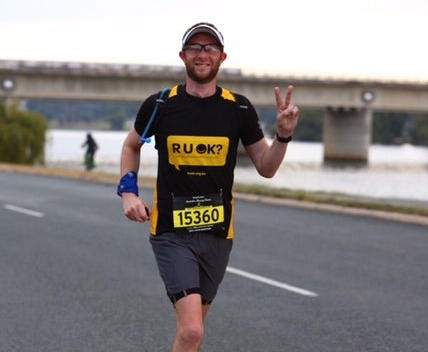
I then saw my family before the 30km mark and got some much needed ‘high fives’ from my daughters! Just after I passed 30km a mate from my running club took this great photo while I was recording a bit of my trip on the GoPro. I’d aimed to be there at 2 hours 50 minutes, and I was more than three minutes ahead of that goal!
Until now we had been running on just the south side of the lake. We looped around and up on to Commonwealth Avenue bridge running away from Parliament House. I got all the way across, past the ANU and to the base of Black Mountain (home of Telstra Tower) before beginning to feel a little tight in my calves. So, at 35km I finally slowed down and stretched out. The mental battle was beginning, but I was still three minutes ahead and I had budgeted that I was going to slow down.
Not much further ahead I caught up with two mates running the marathon and after sharing some positive vibes with each other we hit the turn around and faced a 5km slow uphill grind toward the Kings Avenue bridge to cross the lake again. Around half way along that stretch at around 41km I saw my family again and got juiced up with some more ‘high fives’ from my daughters and with bits of ‘walk then run’ I got onto the bridge and passed the 45km marker still a minute ahead of my goal. I passed 45km in 4 hours 19 minutes leaving me 41 minutes to get the remaining 5km knowing I could walk parts and easily meet my goal if I kept clear of any injury, and I felt tired but wasn’t hurt.
I was about to pass where I had seen my mum earlier and being ahead of target I passed that spot while mum was running to the path to cheer - which she was failing at. I sang out to her that I’d be at the finish in less than 15 minutes. There was a final drink station with about 1.5km remaining which bought me a final chance to walk a little and get a little more fluid in before jogging by the final kilometre marker.
Now the adrenaline began to build again. 4 hours and 45 minutes into my race and there was a palpable excitement building. As I got onto King Edward Terrace passing the Australian National Gallery the crowd was starting to build. I could feel my energy picking up and as I crossed the road into the finish chute with a few hundred metres to go my breath shortened, I was about to cry because I could feel the pride rising. I was almost finished. Then not far up the I spotted my family. My daughters ran towards me and met me with about 100m left. My little prideful gasps of emotion were nothing compared to the cracked voice and the tears that began to run down my cheeks as I held their hands, one on each side. We ran the last part together, my older daughter seemingly skipping along and my younger daughter playfully running. Me weeping openly as we approached the line. It was a moment I worked months for, ran 5 hours for and enjoyed for the fleeting minute that it lasted knowing full well that I will remember it for my entire life.

Q. What an achievement! How did it feel to hit your goal?
I am proud of my effort and that I finished almost 10 minutes ahead of target at 4:50.51. I am even prouder that this run and my other best run two years ago at this event’s half marathon have both been in support of R U OK?. Between the two events I have been supported by family, friends, colleagues, runners and social media followers who’ve helped me raise funds for R U OK?
I’d like to thank Louise and the team at R U OK? for their help and their encouragement. I hope my efforts have helped inspire more people to reach out to the people in their world who may be struggling with life and ask, “Are you OK?”
Keen to raise funds and awareness for R U OK? head to https://www.ruok.org.au/join-a-fundraiser to see how you can get involved.